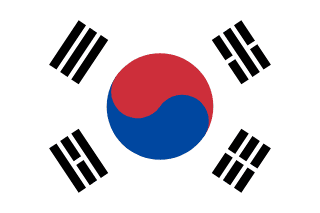
South Korea
🇰🇷 Eastern Asia · Republic of Korea
How South Korea ranks globally
About South Korea
South Korea (officially Republic of Korea) is a country in Eastern Asia, with Seoul as its capital. It is home to roughly 51.68 million people, giving a population density of about 516 people per square kilometre. The country covers 100,210 km² of land and shares land borders with 1 neighbouring country. Its economy is valued at approximately $1.87T in nominal GDP (2025), and it records a Human Development Index of 0.937. The official currency is the South Korean won (KRW), and the main language is Korean.
Key indicators
💹 Economy
👥 People
🌍 Quality of Life
GDP over time
How South Korea measures up
How South Korea is governed
Head of state and government; holds executive power (single 5-year term).
Leads the executive; a Prime Minister assists but is subordinate.
Unicameral — National Assembly — 300 elected seats
Who holds the power?
South Korea is a presidential republic. The directly elected President is both head of state and government and serves a single five-year term with no re-election — a rule designed to prevent the concentration of power seen under earlier authoritarian rule. A Prime Minister, appointed by the President, assists but does not lead the government. The unicameral National Assembly makes the laws, and a powerful Constitutional Court can remove a president through impeachment.
Did you know?
South Korea is the 29th most populous country in the world, with about 51.68 million people.
By land area it is the 107th-largest country in the world, covering 100,210 km².
It has the world's 13th-largest economy by nominal GDP ($1.87T).
South Korea shares land borders with 1 country.
It is classed by the UN as a country of very high human development, with an HDI of 0.937.
South Korea has a population density of about 516 people per square kilometre.
Quick quiz — do you know South Korea?
What is the capital of South Korea?
Travel & practical
Some links are affiliate links — we may earn a commission at no cost to you.
Neighbouring countries

More countries in Asia


Explore more: all countries · all comparisons